

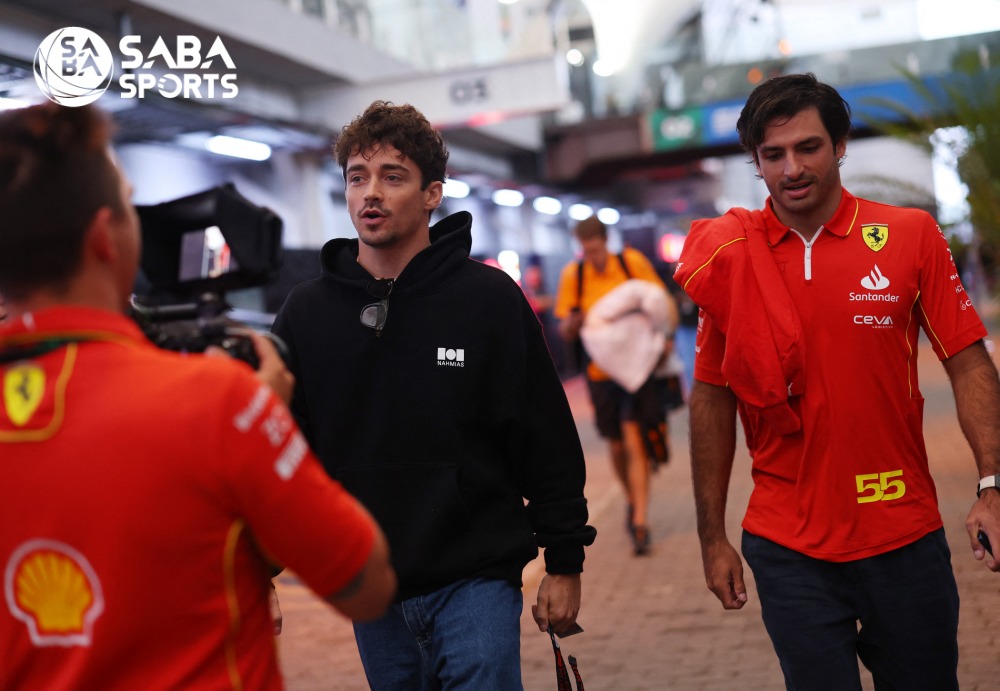
Source: REUTERS/Amanda Perobelli
[Saba Sports News] At the F1 Las Vegas Grand Prix, the biggest challenge faced by teams during tuning is the cold environment. During night races, tire temperatures can drop quickly. Therefore, the cold environment is a more critical parameter than at other tracks. To address this, the Ferrari team designed a mathematical model and conducted extensive testing on dynamic simulators and computational fluid dynamics (CFD) to determine aerodynamic configurations and mechanical settings for the suspension. Before the race, Racing News 365’s technical expert Paul Felicity explained how Ferrari will use this mathematical model at the F1 Las Vegas Grand Prix to ensure that the tires quickly reach the optimal working temperature range while striving to maintain those thresholds. Paul Felicity stated that thanks to the data collected in Nevada last season, Ferrari’s engineers were able to significantly improve the mathematical model for the internal energy/heat transfer of the tire, depending on the compounds used. More specifically, the transitions experienced by these compounds at specific internal temperatures ultimately determine the range for maximum performance and mechanical grip. This mathematical model can simulate changes in tire temperature, thereby eliminating and addressing the balance issues encountered by the Ferrari team after introducing aerodynamic developments at the Spanish Grand Prix.