

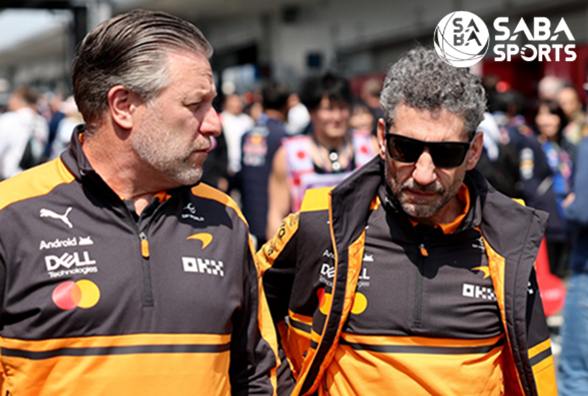
Source:REUTERS/Jakub Porzycki
[Saba Sports News] The 2026 season has seen a clear divergence among teams in their understanding and utilization of power units. Andrea Stella, Team Principal of McLaren, admitted after the Japanese Grand Prix that as a customer team of Mercedes, the biggest constraint they currently face is not engine performance itself, but a disadvantage in the time window, which has kept them playing catch-up in the early stages of the season.
Unlike works teams, which gain earlier access to and can optimize their power systems sooner, customer teams often have to complete the integration of their chassis and power unit under a much tighter schedule. Stella pointed out that this season, progress on both car development and engine preparation has been pushed to the limit. McLaren’s MCL40 was only fully ready at the last minute, with the power unit supplier facing similar pressures. Under such circumstances, customer teams inevitably fall behind at the start.
Stella emphasized that the issue does not lie in a lack of transparency or restricted cooperation. He stated that McLaren maintains highly open communication with Mercedes High Performance Powertrains, with both parties sharing technical information to the fullest extent, and there is no deliberate withholding of data. The current gap stems more from the adaptation process itself: how to fully understand and unlock the potential of the power system within limited time.
In the author’s view, the complexity introduced by the new regulations has placed all teams in a rapid learning phase. Every component—chassis, gearbox, and power unit—requires constant adjustment and fine-tuning, and the learning curve is inherently steep. For customer teams, this process of catching up and learning is even more pronounced.