

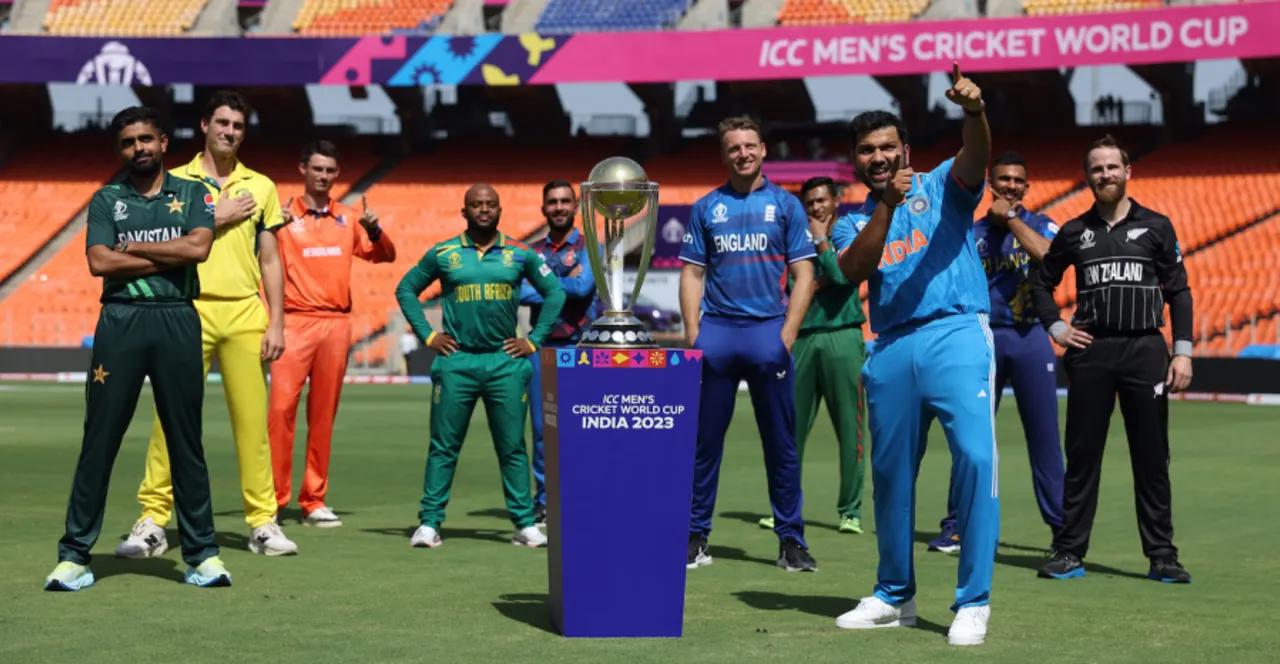
Image Credit- ICC
Cricket World Cup League 2’s first of 24 triangular
series last week in Kirtipur marked the beginning of the route to the next
fifty-over World Cup. An expanded competition, the 2027 tournament is slated
for October–November and will feature 14 teams fighting over 54 matches across
South Africa, Zimbabwe, and Namibia, with some teams travelling a scenic route
to the main event. We’ll take you on this lengthy journey right here:
Eight of the other ten top-ranked teams in the ICC’s
ODI rankings, as well as Zimbabwe and South Africa, two of the three co-hosts
qualify automatically. As of right now, those are Afghanistan, Bangladesh,
England, India, Australia, Pakistan, New Zealand, and Sri Lanka; but, as the
event approaches, those may change.
The third host, Namibia, is currently placed 16th in the ODIs and will need to
proceed through the qualification process. In the event that they are unable to
attend the tournament, there is a possibility that matches would take place in
Namibia even though Namibia is not a part of it. And that would mark the first
World Cup in which one of the host countries is not represented.
Namibia competes in the eight-team World Cup Cricket
League 2, which takes place over the course of the following three years. The
four teams that place highest in that competition advance to the World Cup
Qualifier.
The final four will play the top two teams from the Challenge League—basically
the third division—in a playoff competition. The World Cup Qualifier Playoff, a
mini-tournament with a format to be established, will be played by these teams
after which the top four advance to the World Cup Qualifier, from which four
teams advance to the World Cup in turn. As a result, League 2 teams have two
chances to advance to the qualifier, and it also creates the chance that a team
lower down could earn a place at the main event.
Namibia is known to be in League 2. They are joined by
Canada, who were promoted from the Challenge League, Scotland, UAE, USA, Nepal,
and Oman, who were all involved in last year’s World Cup Qualifiers, and
Netherlands, the only team from the now-defunct World Cup Super League (and the
only Associate nation in that league).
Between now and December 2026, these eight countries will compete in nine
triangular series, with each side playing four matches total—36 games per team,
or 144 ODIs—in all.
The Challenger League consists of 12 teams, some of
which are being decided as we speak. Competitions are being held in Malaysia
and Vanuatu, with the final round set for March 3.
As of right now, the Challenge League has confirmed the participation of Papua
New Guinea, Jersey, Denmark, Hong Kong, Kenya, Qatar, Singapore, and Uganda.
The remaining four spots in the lineup will go to Italy, Kuwait, Saudi Arabia,
Bahrain, Malaysia, Tanzania, and Vanuatu.
Following that decision, the Challenge League teams
will be split into two pools of six, with each playing three round-robin
tournaments for a total of ninety matches during the cycle. The World Cup
Qualifier will be played by the top two teams from each pool.
Ten teams will compete in the World Cup Qualifier: four from League 2 and four
from the Challenge League, as well as the teams ranked 11th and 12th, or those
Full Members who are not automatically qualified. Four of those will qualify
for the World Cup in 2027.