

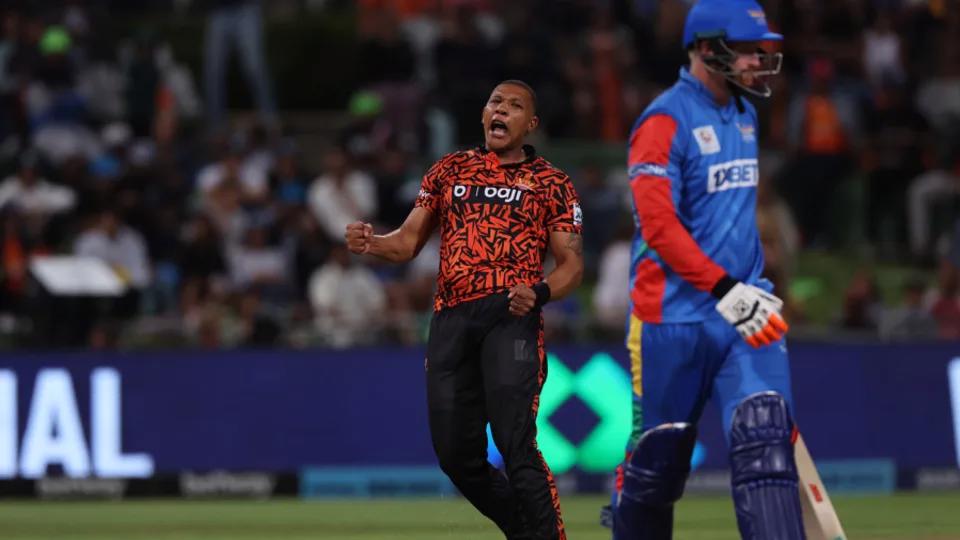
Image Credit- SA20
Sunrisers Eastern Cape heard Durban’s Super Giants
captain Keshav Maharaj’s assertion that character, not skill, wins trophies and
decided to simplify it. “Bowlers win you trophies,” Sunrisers skipper
Aiden Markram said on the eve of the final. “But I’m a batter, so I sort
of disagree.”
Markram was partially correct when his lineup scored
204, which was more than enough to upset Super Giants and far above the
first-inning average of 172 at Newlands. Still, his original point was valid.
With the top three wicket-takers in the competition among their ranks,
Sunrisers made it to the championship game thanks to their bowlers. Except for
the day that really mattered, when they thrashed Sunrisers to a second title,
their diverse and skillful attack had someone for every situation and carried a
batting line-up that Markram acknowledged was ‘parts and pieces but just found
a way to get us over the line’.
In terms of outcomes and entertainment value,
Sunrisers have played and timed the ideal championship run over the past month.
Sunrisers participated in five and won four of the competition’s eleven close
games (those decided by 10 runs or fewer, or with six balls left or fewer),
demonstrating their constant ability to provide entertainment. Conversely, and
perhaps more crucially, their performers were erratic.
They won seven league titles, and each time, a
different individual was acknowledged as the game-changer. That is the best
example of a team that is greater than the sum of its parts, and veteran coach
Adi Birrell is the one who brought that about. He is a cunning politician who
assembles teams with no obvious standouts but gets the most out of them.
Ottniel Baartman has declared himself a contender for
the T20 World Cup after finishing as the second-highest wicket-taker in the
SA20. Given his supply of slower deliveries, South Africa might do worse than
give him a chance, particularly for the Caribbean leg.
Tristan Stubbs could soon be given the same kind of
responsibility. His winning 56 indicates that he is prepared for a more
significant position in the national T20 team, where he hasn’t yet made his
debut.
Alongside Stubbs was his captain, Markram, the head of
the national T20I team, who also spoke highly of himself and his ability in
this competition. Markram is a taciturn yet wise leader who can manage a
diverse team of athletes and manage them well both tactically and personally.
All things considered, season two of SA20 will go down
as a success. Remarkably, nearly two-thirds of the South African audience
during the first 17 days of the tournament are over 50, according to data on
viewership, which is up 36% from the previous year.
While all of South Africa’s high-profile cricket,
including the international matches, has been played this summer, this week
sees the return of the domestic four-day competition before the domestic T20
competition (yes, another one!) takes place in March and April. Herein lies
CSA’s chance to profit from all they accomplished during the course of two SA20
seasons.
Despite the fact that the SA20 teams and the
provincial teams have different brand identities, there are geographical
relationships between them, and the popularity of the format in addition to the
fact that it is a World Cup year should encourage CSA to invest in marketing
and ticket sales. They only need an excuse to watch cricket; they don’t need to
have the whole franchise tournament experience, complete with stilt walkers,
live music, and incentives for taking crowd catches. And the SA20 has demonstrated
that South African players supply an abundance of that.