

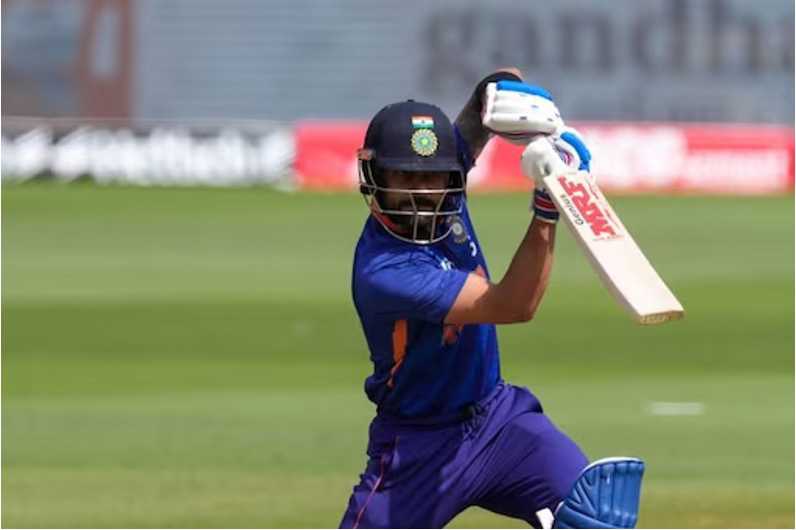
Image Credit- AP
The middle of the bat is where the ball pings off.
Poof. It’s an outside-off rasping slog-sweep. During the powerplay, both of the
outfielders are on the leg side, wide long-on and deep midwicket, but neither
has the opportunity to cut it off.
For big-hitters in Twenty20 cricket, the slog is one
of the most productive smashes due to its versatility. Even in his most
explosive moments, Virat Kohli isn’t much of a slogger and prefers to time the
ball. Playing his first T20I in more than a year nevertheless, he was prepared
to slug at a spinner in the powerplay.
Not just any spinner, either. Mujeeb Ur Rahman has the
ability to turn the ball in both directions and even cause it to swing. Around
the world, T20 and T10 competitions are in demand for him.
In T20 cricket, Kohli has experienced his fair share
of difficulties against spin bowling and has always been reluctant to take
chances against it. However, on Sunday, he ripped up the previous template and
became agitated. He hit 29 off 16 balls, with five fours. Of those sixteen
balls, he attempted to hit half to the boundary. He hit a strike rate of 257.14
and took Mujeeb for eighteen off seven balls by himself.
Kohli had the option to ease his way in during a
mediocre chase of 173 against an Afghanistan assault that was not led by Rashid
Khan. However, he didn’t. Rather, he batted with intent and seems completely
attuned to the style of T20 cricket played today. The fast outfield and flat
Indore surface undoubtedly aided Kohli, but it was evident that his batting
strategy had changed. With less than six months until the T20 World Cup in the
USA and the West Indies, a plan is beginning to take shape.
Even Naveen-ul-Haq was slogged wide of long on by
Kohli. In addition, he ran to Fazalhaq Farooqi from the crease. He kept
flinging his hands, hips, and shoulder at the ball despite the rare
play-and-miss. When he missed, he corrected himself. When he couldn’t exactly
replicate the six off Haris Rauf from the Melbourne 2022 T20 World Cup, he also
chastised himself. For the record, this ball that was the source of Kohli’s
resentment had nearly gone over the rope for six.
There was very little justification for pushing so
hard, once more. This was a decision taken by a superior batter who was
prepared to adjust to his surroundings. Kohli ended up slicing it to mid-off
when he attempted to push another boundary down the ground off Naveen. Then he
took a seat back in the dug-out and observed Shivam Dube and Yashasvi Jaiswal
working with a similar great intent.
Rohit Sharma, the captain of India, has also abandoned
the safety-first T20 batting strategy. He might have taken his time to calm
down in the second Twenty20 International in Mohali after being run out for a
duck in the first one, but he decided to go hard right away. He took a step
back and swung, but his off bail was cut.
Before the World Cup in June, India will play just one
more Twenty20 international match, this Wednesday in Bengaluru, but Rohit has
had enough. The way his batters are refusing to go backwards made him very
happy.
T20 can overtake anyone with its lightning-fast speed.
India is more aware of that than most, especially with regard to Rohit and
Kohli. They continued to do the same thing, which is why their previous two
World Cup campaigns were not very successful. There is a genuine need right now
to take action.