

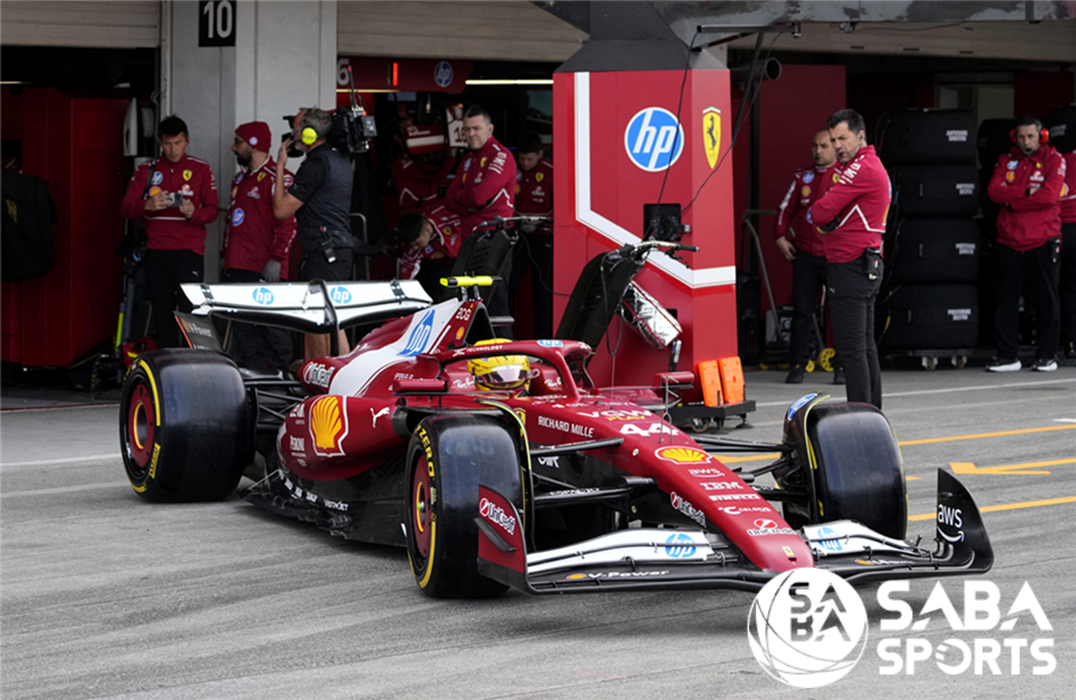
Source: REUTERS/SHUJI KAJIYAMA
[Saba Sports News] Yesterday, the media exposed on-board footage from the Suzuka circuit. Among them, one image left a deep impression on fans—Lewis Hamilton’s SF-25 car, like a wild horse, wildly swinging its tail in high-speed corners. In response, 1997 F1 World Champion Jacques Villeneuve pointed out during the live broadcast: “This is not driving, but fighting with the steering wheel. This Japanese Grand Prix completely exposed the systemic collapse of the rear grip of the Ferrari car.” Technical data shows that Hamilton’s car had a lateral slide of 4.3 degrees at the 130R curve, 67% more than Charles Leclerc. What’s more deadly is that to prevent the floor from being canceled again due to wear, the team was forced to raise the chassis height, resulting in a 12% reduction in downforce. F1 commentator David Croft discovered a more terrifying detail: when Mercedes cars could stick to the curve center, Ferrari cars had to brake early and take an exaggerated outer line, which caused Hamilton to lose at least 0.4 seconds per lap. In response, some fans said that the crisis stems from the helpless choice of the Maranello factory: sacrificing structural rigidity for weight reduction, weakening rear downforce for straight-line speed, and raising the chassis to avoid violations. This triple contradiction in technology makes Hamilton perform an extreme car-saving performance every lap.