

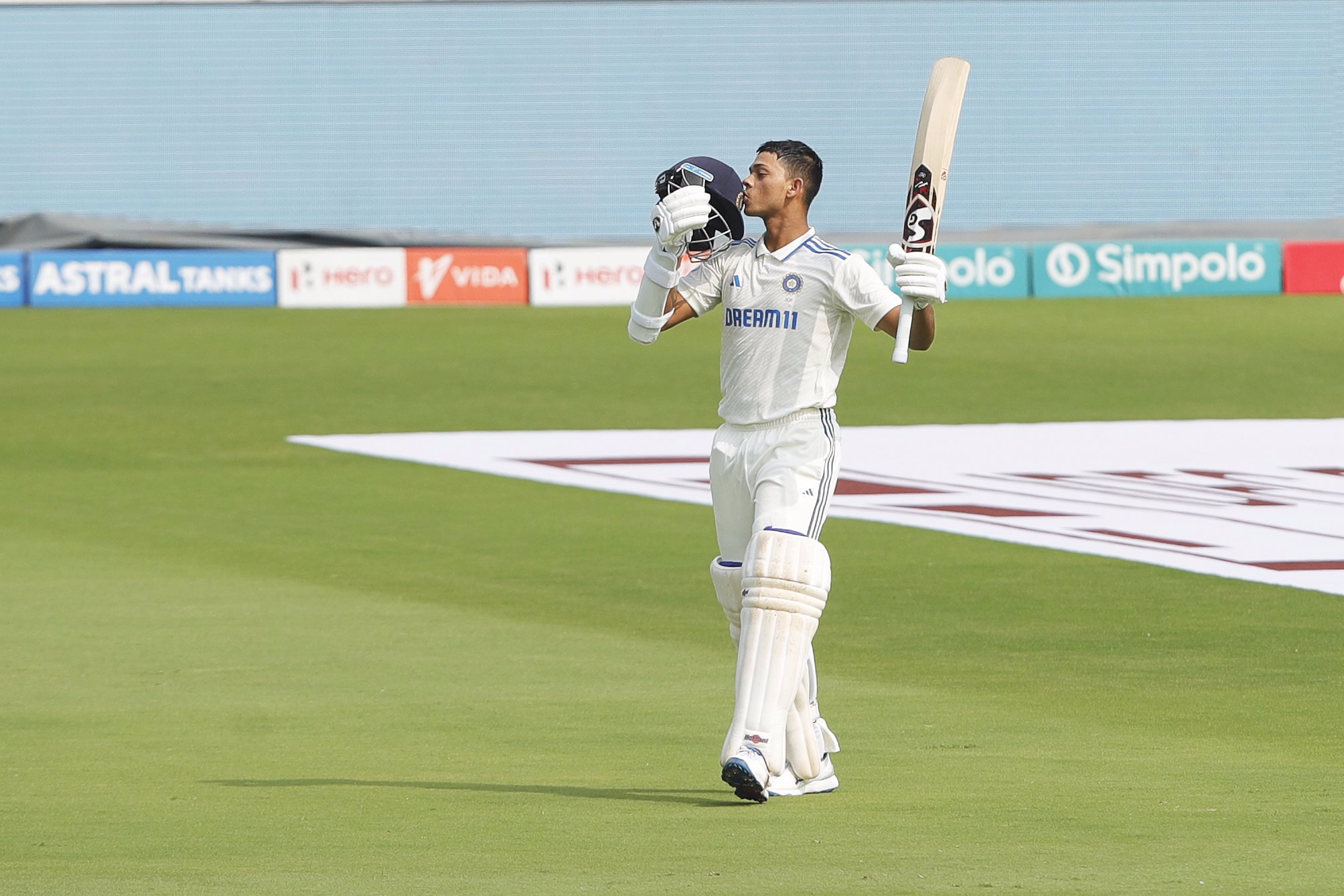
(Image source: X.com)
[Saba Sports News] Yashasvi Jaiswal, India’s young batting sensation and aggressive opener, illuminated the second day of the second Test against England in Visakhapatnam with a splendid display of batting prowess. His monumental innings began on Day 1, where he remained unbeaten at 179, joining the ranks of six Indian batsmen with the most runs on the first day of a Test match.
The anticipation soared as the second day commenced, with all eyes eagerly fixed on Jaiswal’s quest for a maiden double century. Remarkably, he achieved this milestone in just 20 balls on day two, punctuating it with an emphatic boundary.
Jaiswal’s 277-ball double hundred was a spectacle for Indian fans, standing out as the lone batsman to exceed 35 runs in the first innings. It marked the first double century by an Indian opener since November 2019 when Mayank Aggarwal tallied 243 runs against Bangladesh.
Jaiswal’s innings came to a halt after adding a mere nine runs to his double ton, falling victim to the veteran England pacer James Anderson.
At 22 years and 37 days old, Jaiswal, with only five Test matches under his belt before this encounter, shattered longstanding records, etching his name into cricketing annals.
He became the third youngest Indian batsman to achieve a Test double hundred, following in the footsteps of Vinod Kambli’s 224 runs against England in 1993 (21 years, 35 days), Kambli’s 227 runs versus Zimbabwe in 1993 (21 years, 55 days) and Sunil Gavaskar’s 220 runs against the West Indies in 1971 (21 years, 238 days).
In addition to this historic milestone, Jaiswal secured another accolade by becoming the first southpaw for India to smash a double century in Tests since 2008. Former India left-handed batsman Gautam Gambhir was the last to achieve this feat. On Saturday, Jaiswal joined an esteemed club of left-handed Indian batsmen to score double centuries in Tests, alongside Sourav Ganguly (239 vs Pakistan, 2007), Kambli (227 vs Zimbabwe, 1993 and 224 vs England, 1993) and Gambhir (206 vs Australia, 2008).