

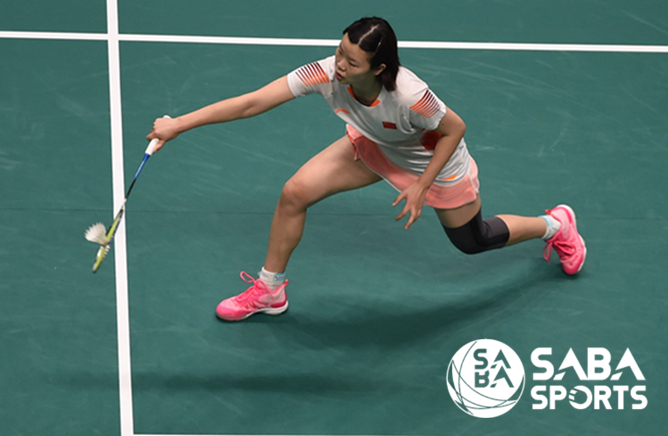
Source:Oriental Image/Stringer
[Saba Sports News] Last week, applause echoed in the Hangzhou Bay Joint Innovation Center as a Guinness World Records official declared that a badminton robot, developed by a top talent team from Shaoxing City, had successfully set a new world record for “the most consecutive badminton rallies with a mobile robot,” achieving an impressive total of 1,452 rallies. The challenge was a true “showdown between human and machine.”
Faced with incoming shots from the former world champion in women’s singles badminton, Lu Lan, and Zhu Si, the women’s singles champion from the 14th Sports Games in Shaoxing’s Shangyu District, the robot demonstrated remarkable agility. It utilized a high-speed visual tracking system to instantaneously capture the shuttlecock’s trajectory, while an autonomous motion control algorithm executed path planning in milliseconds. The robot’s high-dynamic movement system enabled it to glide smoothly, make sharp stops, and change direction, while its precise striking system ensured that every incoming shuttlecock was accurately returned to the designated area.
Through repeated exchanges, the robot maintained a stable rally rhythm, ultimately achieving 1,452 consecutive strikes and successfully setting a new Guinness World Record. In my view, the fast speed and variable landing points of badminton posed an extreme challenge to the robot’s visual recognition, real-time computation, and motion control abilities. This record-breaking badminton robot stood out due to its millisecond-level perception and decision-making capabilities.