

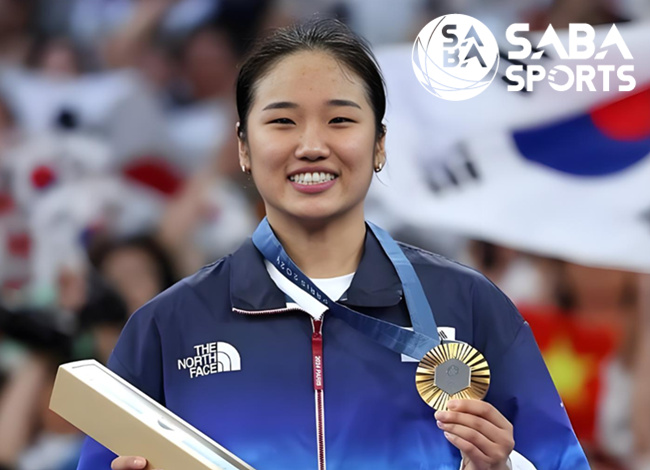
[Saba Sports News] South Korean coaching staff’s transformation of An Se-young over the past two years has not been about “teaching her to play badminton”, but about carrying out “precision engineering”.
In her early career, An Se-young was a “fighter” who only knew how to dash all over the court. However, the Korean coaching team managed to shift her hitting point half a step forward.This seemingly small adjustment required advanced footwork restructuring and complete muscle-memory reprogramming. In terms of macro management, the Korean team even adopted a “load management” philosophy similar to that used in the NBA. Badminton is a high-intensity intermittent sport, with an average heart rate of 170–190 beats per minute during a match and peak blood lactate concentration reaching 8–12 mmol/L. Athletes perform more than 300 directional changes and over 50 jumps per match, with anaerobic metabolism accounting for up to 60% of energy expenditure.
Using sports monitoring devices, the Korean team collected real-time data on An Se-young’s training load and fatigue levels. Based on this data, they dynamically adjusted training intensity and recovery cycles to achieve “precision training”, avoiding overtraining and injuries. The team also used high-speed cameras and 3D motion capture systems to analyze her footwork and stroke mechanics, optimizing her power chains for net kills and rear-court attacks to improve efficiency and reduce energy consumption. It is clear that An Se-young’s dominant performance stems from precise calculation across six dimensions. Her serve placement error is within 5 centimetres, her forehand smash reaches 378 kilometres per hour, and her core muscles can generate 2.3 times her body weight when retrieving defensive shots. Behind these figures lie six hours of targeted training prepared for her by the Korean coaching team every day.
In my opinion, An Se-young’s success comes down to three factors: first, her natural talent and self-discipline; second, the proactive adoption of scientific methods across different sports; and third, the scientific training provided by her coaching team.